
September 9, 2021

Everything You Need to Know About Venting for Successful DIY Plumbing Work

Author

Update First Last in Content -> Business Text -> First Last field

Date

September 9, 2021

Share

When planning a remodel that requires plumbing, venting is one of the most important considerations. Learn must-know information on vent types, drainpipes, and more venting tips.

Drain-waste-vent (DWV) pipes carry waste and water smoothly out of the house without gurgles or fumes. This requires an air passageway behind the water. Vent pipes extend from the drainpipes up through the roof to provide that passage while also carrying odors out of the house. Figuring out how the drain will be vented in one of the first steps  as you plan for plumbing  a new appliance or an addition to your system. However, it's not always an easy solution to find. When  developing a plumbing system plan , you can choose from several venting types, and each option could present problems or complications. Get the details on each type of drain vent below to assist you in planning your remodel. Before finalizing a plan, make sure to have the venting scheme approved by a local plumbing inspector.

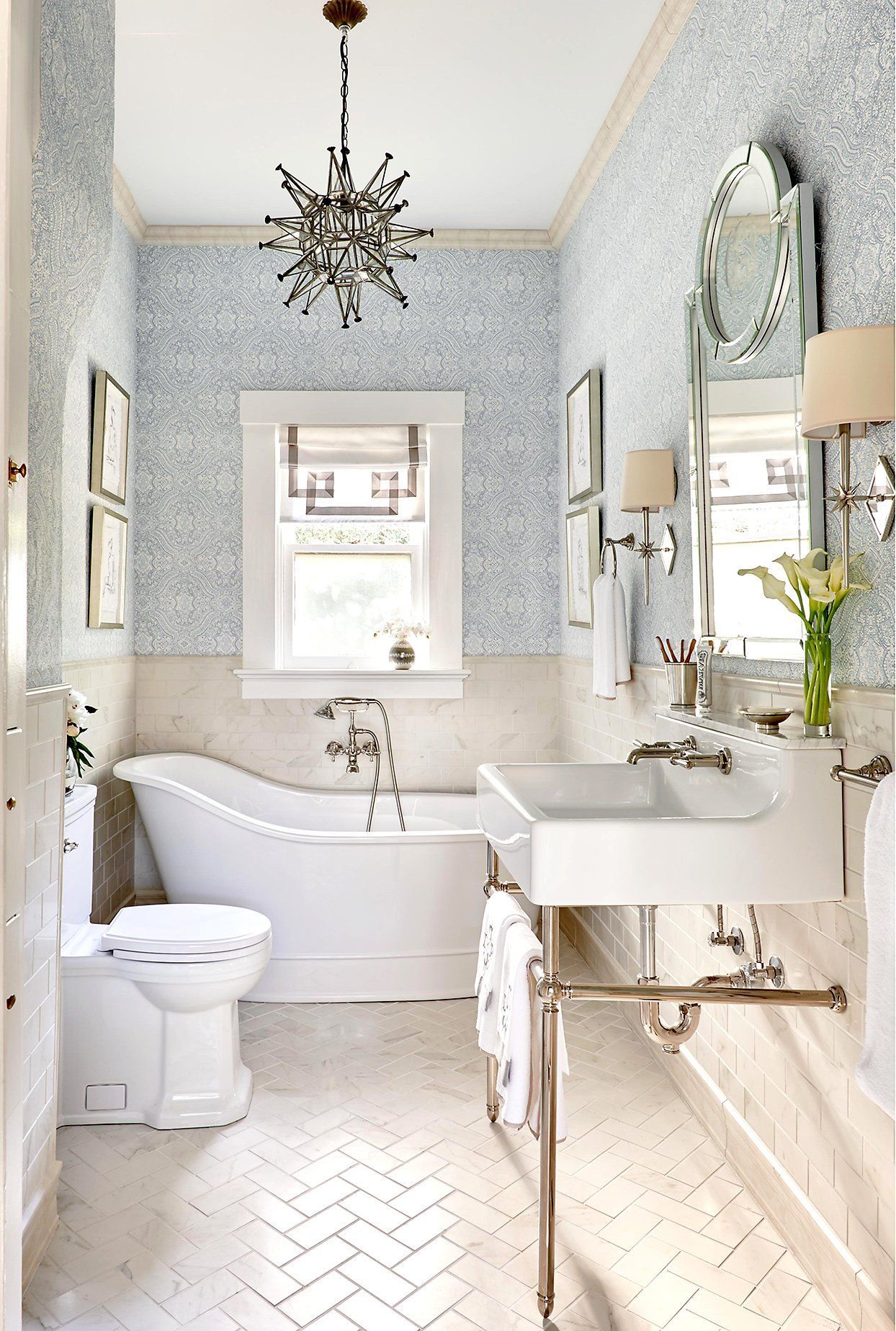
Elegant bathroom with blue patterned wallpaper, clawfoot tub, and pedestal sink.

Why Is Venting Necessary?

Try to quickly empty a bottle with a narrow mouth; it will gurgle and glug as it slowly empties. Open the vent cap on a plastic gas container and it flows smoothly. That's because the vent hole allows air to enter behind the flowing liquid, producing a quick, glug-free flow. Vent stacks in a household plumbing system work the same way. The centerpiece of a DWV system is the  main stack , usually a pipe 3 or 4 inches in diameter that runs straight up through the roof. A  secondary stack , perhaps 2 or 3 inches in diameter, serves a branch of the system.  Branch drainpipes  of smaller diameter (typically 1-1/2 or 2 inches) carry water from specific fixtures to a stack.

Vent Types to Know

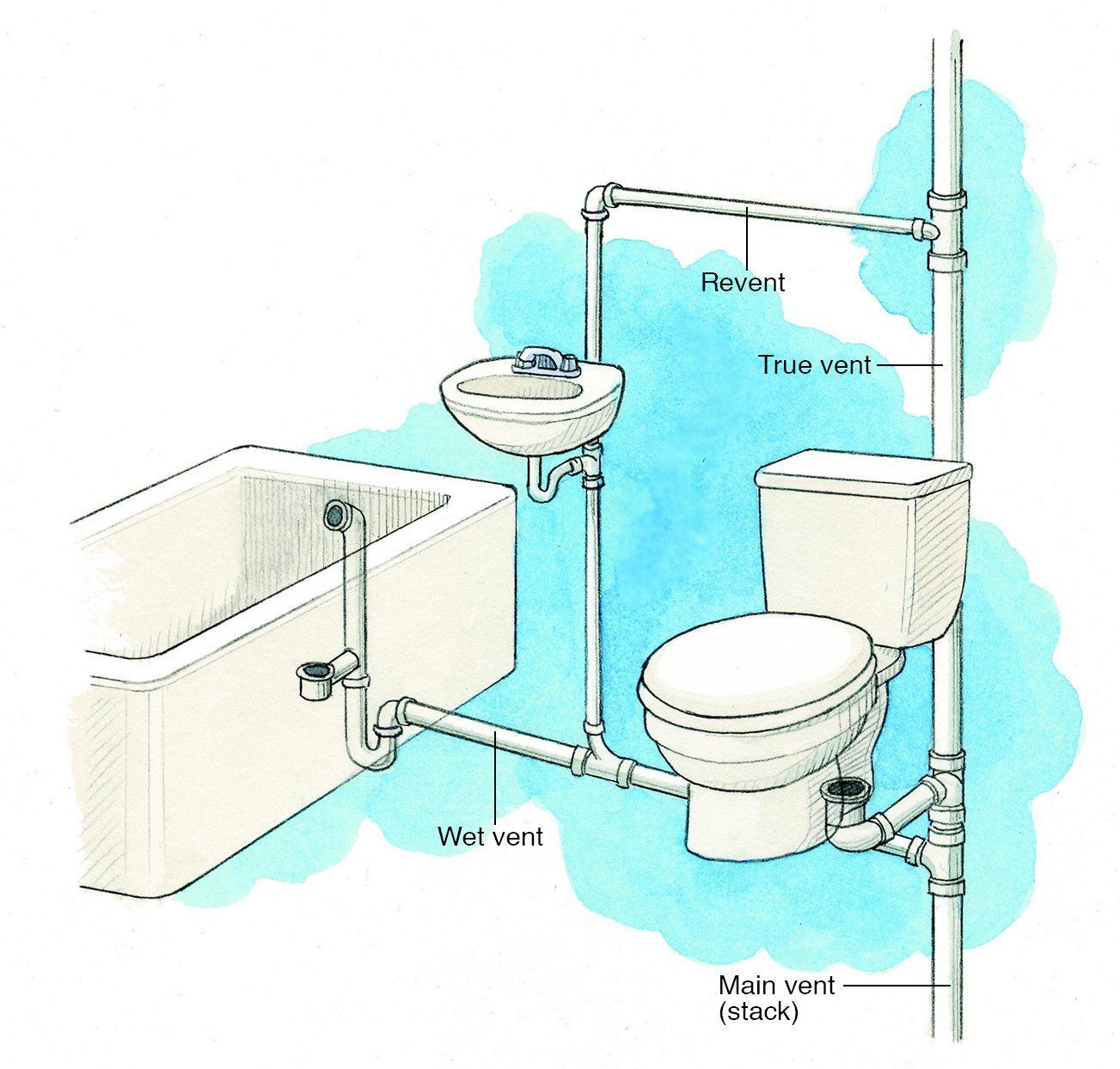
true vent  is a vertical pipe attached to a drain line that travels through the roof with no water running through it. If a fixture is close to the stack and on the top floor, the upper part of the stack serves nicely as a vent. Many fixtures are not so conveniently located, however, and other solutions must be found.
revent  pipe, also called an auxiliary vent, attaches to the drain line near the fixture and runs up and over to the main vent. It can attach directly behind the fixture or to the horizontal drain line.
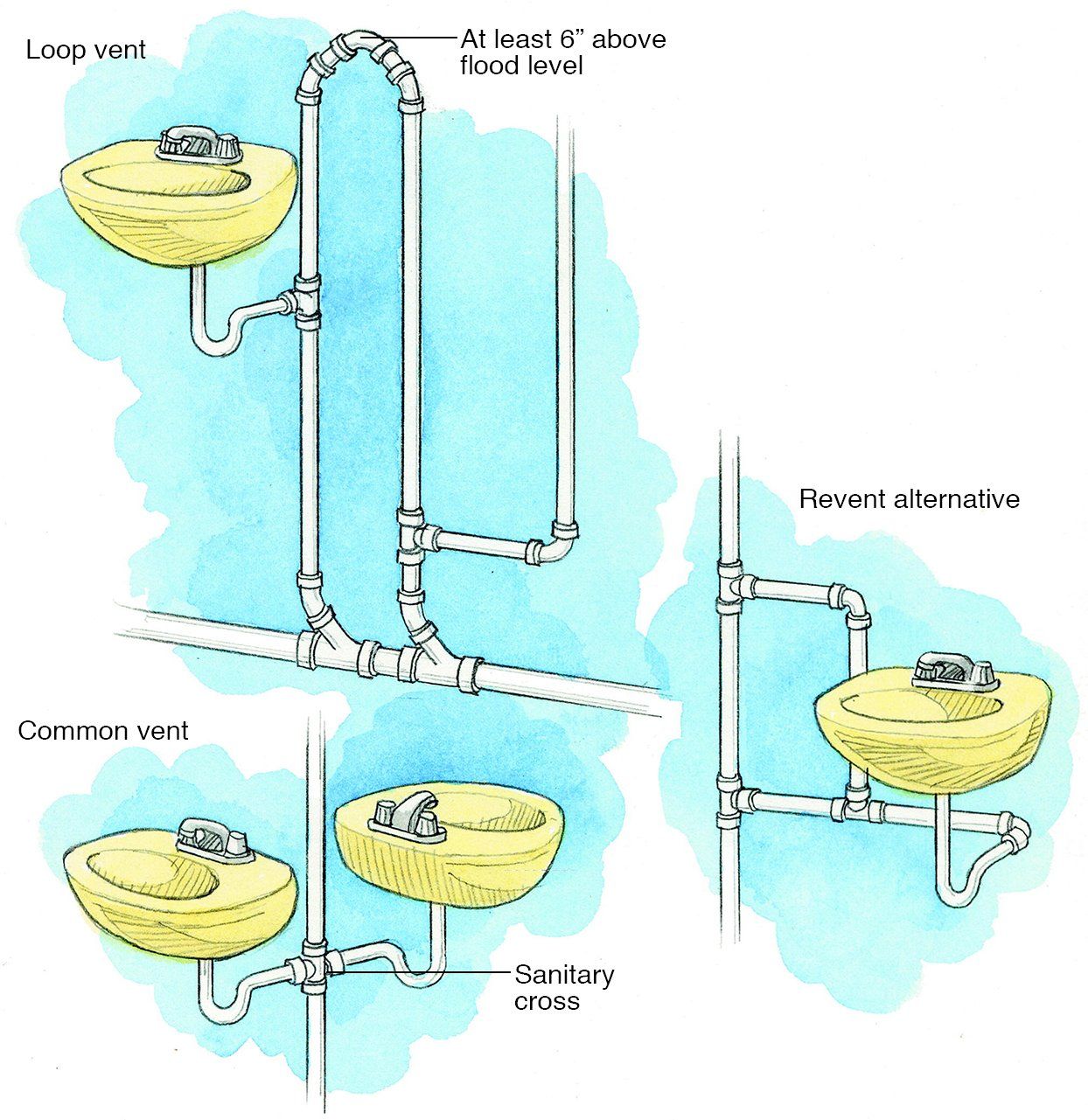
If two fixtures are on opposite sides of a wall, they can tie into the stack with a sanitary cross. This is called a  common vent  and can be found on back-to-back sinks.
When a fixture is close enough to a stack, a wet vent might be allowed by code. In the case of a tub that is close to a stack, its drain can empty into a pipe that also serves as a vent.
For a freestanding sink, code might allow a  loop vent . If reventing is difficult and wet venting isn't allowed, you might have to install a separate vent pipe through the roof.
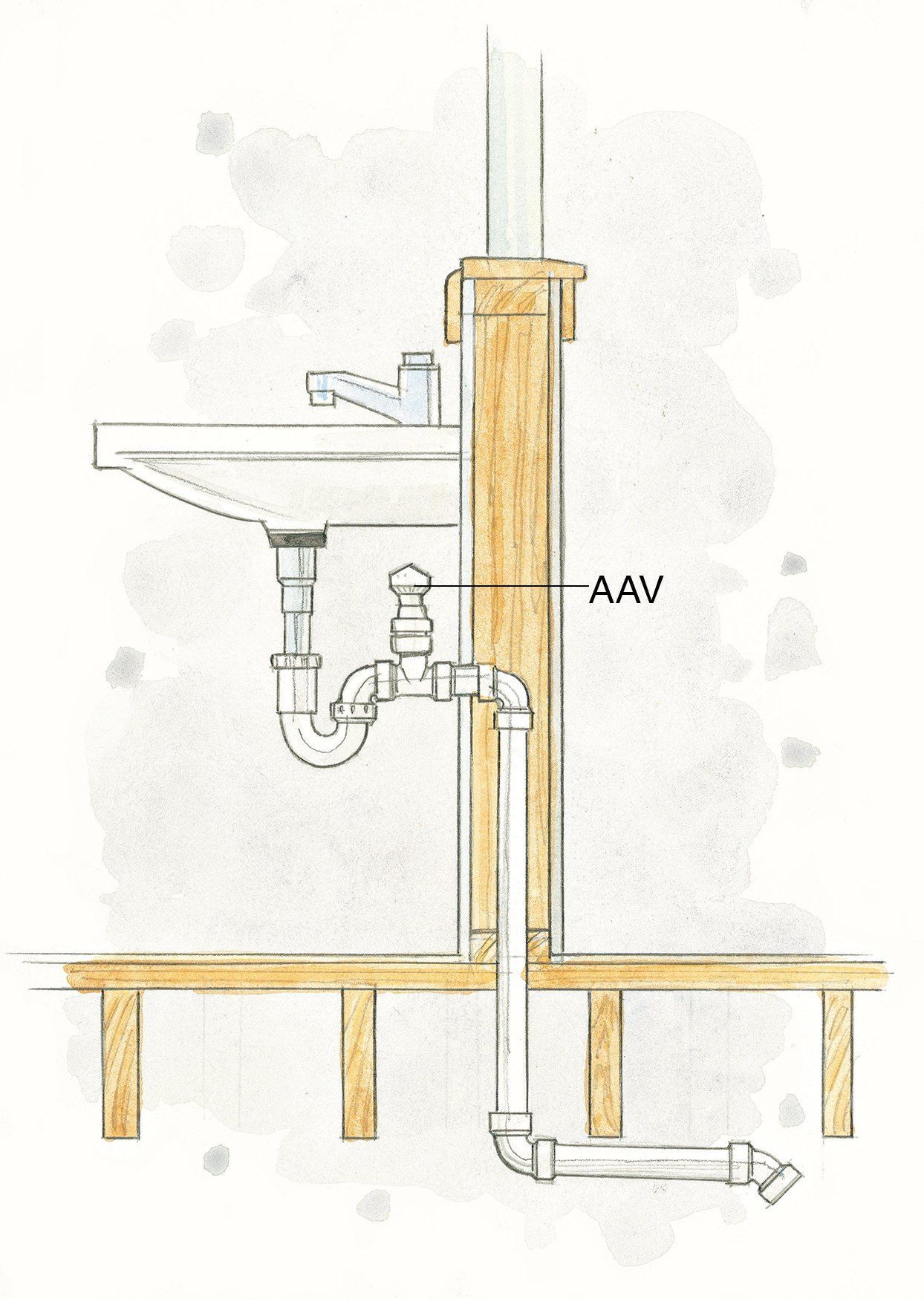
An air admittance valve (AAV) opens to let air in when waste drains, then gravity closes it to keep sewer gases from escaping back into the room. Codes in many localities allow these relatively new devices to take the place of vent lines. Depending on the size of the unit and any code restrictions, AAVs can be used to vent multiple fixtures. Check codes to make sure they permit AAVs.

How Far Should a Fixture Be From a Vent Pipe?

When you're remodeling your plumbing system, can you install a wet vent, or do you have to install a revent or a separate vent? Finding the answer can involve complicated calculations, based on formulas that can vary from one locale to another. The  critical distance , or how far the fixture can be from the vent pipe, is determined by three factors: the size of the pipe that codes require, the type of fixture you want to install, and the number of fixtures that are already wet vented on the same line. Measure the length of the pipes carefully and consult a plumbing inspector to determine whether wet venting is possible.

Tips for Installing Vent Pipes

Vent pipes, often narrower than drainpipes, need not slope like drainpipes. Normally they run level or plumb unless there is an obstacle to work around.
Vent pipes must be installed so they stay dry. This means that they should emerge from the top of the drainpipe, either straight vertically or at no less than a 45-degree angle from horizontal, so that water cannot back up into them. The horizontal portion of a revent pipe must be at least 6 inches above the fixture's flood level, or the highest point to which water can rise. (On a sink, the flood level is the sink rim or overflow hole.)

What to Know About the Main Drain

Plan drain lines to minimize the possibility of clogs. The general rule is that smaller drainpipes (1-1/4 inches for bathroom sinks and 1-1/2 inches for  kitchen sinks , for instance) lead to larger branch drains. These in turn lead to the main stack, which is the largest pipe of all (typically 4 inches). Because the main stack is also vertical, it will rarely clog.
Water travels downward through the stacks to the main drain line, an underground horizontal pipe that leads to the municipal sewage system or to a septic system. In older homes, the main drain might be made of clay pipe or other porous material. Tree roots sometimes work their way into the main line, causing wastewater to back up into the house. The solution is to call a company that specializes in augering main lines. 

Diagram of bathroom plumbing with bathtub, sink, and toilet, showing vent pipes and waste water flow.

Typical Venting Alternatives

A true vent pipe must remain dry while water runs down the drain. A wet vent also serves as a drain line but is large enough that it never actually fills with water.
In some cases, local codes allow for other venting strategies. For instance, a basement sink might be vented with a special wall vent, which simply runs out the wall. Alternatively, a cheater vent, a small device that draws air from the room rather than outside, might be allowed. 

Plumbing diagram: Sink and drainpipe with an air admittance valve (AAV) and framing.

Venting with an Air Admittance Valve (AAV)

Window framing in this wall prevents the installation of a vent line, so an air admittance valve (AAV) is installed instead. As the fixture drains, the one-way valve opens to balance the negative pressure and draw air back into the pipe before closing again. This helps prevent slow draining, gurgling, or the release of sewer gases into the home. 

Diagram illustrating three plumbing vent systems: loop vent, common vent, and a vent alternative, all connected to a sanitary line.

Other Venting Options

Other common ways to tie vents into a stack include sanitary crosses, revent alternatives, and loop vents installed at least 6 inches above flood level. Check local codes to see which methods are accepted in your area, then choose the method that requires the least number of holes or notches in studs.
Source: https://www.bhg.com/home-improvement/plumbing/drain-venting/?utm_source=pinterest.com&utm_medium=social&utm_campaign=social-share-article&utm_content=20210213&utm_term=undefined

Chrome bathroom faucet with running water into a white sink.
October 17, 2025
Protect your older home’s charm and efficiency with expert plumbing contractors. Tim Rausch Plumbing LLC modernizes systems while preserving history.
Plumber repairs a bathroom sink, using a wrench.
June 17, 2025
If you have a plumbing inspection coming up, here's what you need to do to plan before your local plumbing contractor visits your home.
Plumber with wrench fixing a leaky pipe under a sink. Water is spraying.
July 22, 2024
When we ignore issues that need plumbing service, they often get to be much larger than what they originally were. Read on for what can happen!
Person using a wrench to work on plumbing under a kitchen sink.
February 13, 2024
Are you experiencing plumbing issues? Read more to identify the signs you need to call a professional plumbing contractor.
Bright white kitchen with a wooden island, stainless steel appliances, and gray walls.
September 27, 2022
A leaking refrigerator can feel like a drastic enough situation that you may think it's time to shop for a new fridge. But a leaking refrigerator doesn't necessarily mean that your fridge is on its way out .

Person plunging a white toilet with a black plunger.
September 27, 2022
An overflowing toilet is a relatively common problem that many people have had to deal with, but the commonality of this issue doesn't mean that it isn't a serious situation that needs to be handled quickly. The water from an overflowing toilet can soak into wood cabinetry, seep into the walls, or damage the floorboards, making it easier for mold, mildew, and rot to spread throughout the infrastructure of your home.

Hand turning dial on a washing machine, tools and level on shelf above.
September 27, 2022
A washing machine is an essential appliance to ensure that towels, linens, clothes, and bedding are regularly washed and sanitized. Whether you use a professional cleaner to launder your clothes, take laundry to a local laundromat, or use a personal washing machine in the comfort of your home, it's necessary for your personal hygiene to have clean clothes to wear to school, work, or when you meet up with friends.
Plumbing tools: shower head, faucet, valves, hoses, and sealing materials on a dark gray surface.
July 12, 2022
On the side or top of your water heater tank is a valve connected to a metal or plastic discharge tube pointing downward. The valve is called a T&P valve, or TPR valve, for "temperature and pressure relief."
Basement with white brick walls, open doors, water heater, and various pipes.
July 12, 2022
Boilers and water heaters are important to the heating and water supply operations of the home. While they provide different services to the house—one for space heating , the other for domestic water usage—there is some slight overlap in the form of combined boiler/heater devices.
Empty room with brick walls, two windows, and a shiny, wet concrete floor.
March 29, 2022
Most of the time, your home’s sump pump works efficiently and invisibly in the background. In areas with much groundwater, the sump pump's regular on and off sounds merge with the tapestry of your home life.

Show More